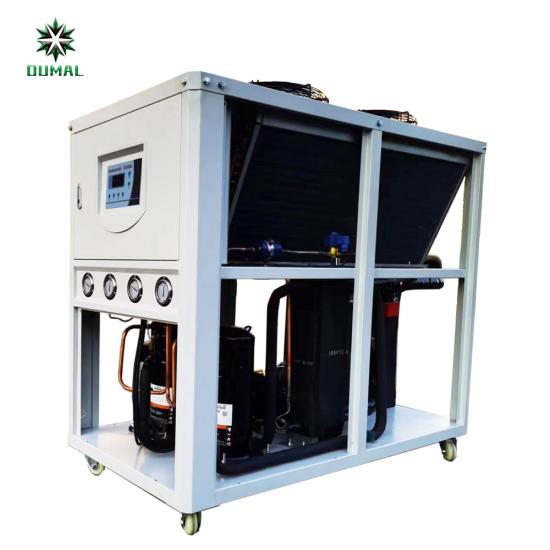

Categorías
nuevo blog
Etiquetas
Información del sistema: Este enfriador scroll especializado hace circular agua enfriada o mezclas de glicol para satisfacer una gran demanda de HVAC y procesos industriales.
Obtienes un control completo sobre la carga térmica de tus instalaciones. Dominar este enfriador te ayuda a optimizar la eficiencia de la planta central, los mecanismos de compresión orbital, los ciclos de refrigeración y la ingeniería del sistema.
Los enfriadores scroll refrigerados por agua utilizan espirales scroll entrelazadas y torres de refrigeración para enfriar el agua de las instalaciones de manera eficiente.
Los enfriadores refrigerados por agua ahorran más energía y duran más de treinta años que los enfriadores refrigerados por aire.
Un ciclo de refrigeración de cuatro etapas extrae continuamente el calor no deseado de tus instalaciones.
Los enfriadores scroll con múltiples compresores ofrecen un funcionamiento silencioso, tamaño compacto y refrigeración de respaldo confiable de energía.
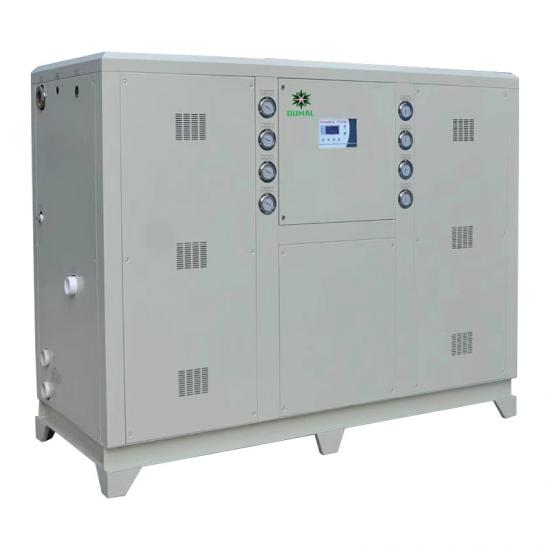
Utilizas un enfriador scroll refrigerado por agua como sistema de refrigeración líquida empaquetado. La unidad enfría fluidos de proceso extrayendo calor mediante intercambiadores avanzados.OUMALlas unidades refrigeradas por agua se conectan directamente a torres de refrigeración externas mediante circuitos de condensador dedicados.
Dentro del equipo, los intercambiadores de calor de carcasa y tubos de alta resistencia o de placas soldadas gestionan la transferencia térmica del fluido. El refrigerante absorbe el calor no deseado del fluido de proceso dentro del evaporador. Después, el enfriador scroll transfiere esta energía térmica al circuito de agua del condensador para su rechazo al exterior.
Debes evaluar las compensaciones financieras a largo plazo al seleccionar equipos de refrigeración. Las unidades refrigeradas por aire ofrecen menores costos iniciales. Sin embargo, un enfriador scroll refrigerado por agua proporciona una eficiencia energética muy superior para operaciones a largo plazo.
|
Categoría de costo |
Sistemas refrigerados por aire |
Sistemas refrigerados por agua |
|---|---|---|
|
Costo inicial de instalación (carga de 200 toneladas) |
$250,000 |
$340,000 |
|
Vida útil promedio |
~15 años |
25–30+ años |
|
Comparación del costo del ciclo de vida de 30 años |
100% de referencia |
58% del costo total refrigerado por aire |
Eficiencia de costos: Los sistemas refrigerados por aire priorizan un menor gasto inicial. Por el contrario, los sistemas refrigerados por agua requieren mayor capital inicial, pero lo compensan mediante menores costos operativos con el tiempo.
Un enfriador de agua central sirve como el centro principal de refrigeración para instalaciones grandes. El sistema hace circular agua enfriada por tuberías aisladas hacia unidades de tratamiento de aire en todo el edificio. Este diseño centralizado elimina largos recorridos de tuberías de refrigerante, reduciendo los riesgos de fugas y mejorando la seguridad.
Tu planta hidrónica gestiona la distribución de líquidos mediante dos circuitos de bombeo distintos:
Bombas del circuito primario: Las bombas dedicadas hacen circular agua a través de cada enfriador de agua a un caudal constante.
Bombas del circuito secundario: Las bombas de velocidad variable impulsan agua enfriada por toda su instalación para satisfacer las demandas de refrigeración activas.
El uso de un enfriador scroll refrigerado por agua dentro de su planta mantiene su gestión térmica fiable y eficiente.
Usted logra un enfriamiento continuo del líquido al impulsar gas refrigerante a través de dos espirales scroll entrelazadas. Una espiral permanece estacionaria mientras la segunda espiral orbita alrededor de ella sin girar. Este movimiento orbital forma bolsas de gas selladas que se reducen gradualmente a medida que se desplazan hacia el centro.
Esta geometría específica minimiza la fricción mecánica interna mientras evita fugas de gas entre las piezas móviles.
|
Parámetro de diseño / Característica |
Detalle de ingeniería |
Función en el control de fugas y fricción |
|---|---|---|
|
Geometría involuta |
Perfil generado a partir de círculos base |
Garantiza un movimiento de compresión más suave y un sellado operativo más ajustado |
|
Holguras de punta y tangenciales |
Mantenidas estrictamente dentro de 0,002 mm |
Bloquea las fugas laterales bajo altas presiones y velocidades de funcionamiento |
|
Polímeros de alto rendimiento |
Fabricados con compuestos de PTFE o aleaciones metálicas |
Reduce el desgaste lateral y minimiza el escape de gas |
|
Acabado superficial |
Rugosidad mantenida en Ra |
Reduce la fricción de contacto entre las interfaces mecánicas |
|
Recubrimientos avanzados |
DLC, MoS₂/PTFE o níquel-fósforo sin electrolisis |
Protege las superficies deslizantes contra el desgaste mientras reduce la fricción de contacto |
El gas de descarga presurizado fuerza a ambos miembros del scroll a unirse durante el funcionamiento. Esta fuerza elimina la necesidad de sellos de punta y mejora la capacidad de sellado mediante un desgaste gradual inicial. Se obtiene una descarga de gas suave sin la vibración pulsante típica de los compresores alternativos. Este diseño aumenta la durabilidad general del compresor dentro de su conjunto de enfriador scroll.
Su enfriador scroll refrigerado por agua depende de un circuito cerrado para extraer el calor de su edificio. Este sistema de refrigeración hace circular el fluido continuamente a través de cuatro etapas termodinámicas principales:
Evaporación: El refrigerante líquido a baja presión entra en el evaporador. El refrigerante absorbe calor del circuito de agua de proceso entrante, enfriando el agua. El refrigerante líquido se transforma en vapor a baja presión.
Compresión: La espiral orbital aspira el vapor a baja presión. La espiral comprime el gas, aumentando rápidamente tanto la presión del fluido como su temperatura.
Condensación: El gas a alta presión entra en el condensador refrigerado por agua. El agua del condensador absorbe el calor del gas, transformando nuevamente el refrigerante en líquido a alta presión.
Expansión: El refrigerante líquido pasa por una válvula de expansión. La válvula reduce inmediatamente la presión del fluido, preparando al refrigerante para absorber calor nuevamente en el evaporador.
Regla del ciclo principal: El compresor crea la diferencia de presión necesaria para impulsar el refrigerante continuamente a través de las cuatro etapas.
Debe descargar el calor del circuito del condensador para mantener el proceso en funcionamiento. El enfriador refrigerado por agua bombea agua caliente del condensador directamente hacia una torre de enfriamiento externa. El aire que se mueve a través de la torre evapora una pequeña porción del agua caliente, reduciendo rápidamente las temperaturas del fluido.
El caudal de agua afecta directamente el rendimiento total de rechazo de calor dentro del circuito:
Influencia directa en la eficiencia: El caudal de agua sirve como parámetro base fundamental que afecta el rendimiento general de enfriamiento.
Equilibrio líquido-gas ($L/G$): Ajustar el caudal de agua modifica la relación operativa de líquido a gas, determinando directamente la tasa de transferencia de calor.
Se calcula el rechazo térmico total ($Q$) en unidades térmicas británicas por hora ($\text{BTU/hr}$) mediante una fórmula hidráulica básica:
$$Q = 500 \times \text{GPM} \times \Delta T$$
El parámetro $\text{GPM}$ representa el caudal de agua del condensador en galones por minuto. El parámetro $\Delta T$ mide la caída del rango de temperatura a través de la torre. Aumentar el caudal de agua amplía la capacidad total de rechazo de calor. Este equilibrio mantiene la máxima eficiencia del sistema y evita disparos por alta presión en su enfriador durante las cargas máximas de enfriamiento del verano.
Depende de conjuntos de compresores scroll OUMAL de alto rendimiento para impulsar el enfriamiento mecánico. Dentro de cada compresor, dos espirales scroll se entrelazan perfectamente. La espiral fija permanece estacionaria mientras la espiral correspondiente realiza un movimiento orbital continuo. Este movimiento suave comprime eficientemente el refrigerante vaporizado. Evita el golpeteo de válvulas y el desgaste severo, lo que prolonga significativamente la vida útil del equipo.
Su enfriador scroll principal utiliza intercambiadores de calor especializados para transferir energía entre circuitos de fluidos. El refrigerante de baja presión dentro del evaporador absorbe energía térmica, generando agua enfriada para sus instalaciones. Luego, el refrigerante entra en la carcasa del condensador para liberar calor hacia los circuitos externos de la torre. Una opción secundaria de enfriador scroll ofrece escalabilidad modular para instalaciones en expansión.
Consejo de mantenimiento: Mantenga velocidades del agua superiores a 0,5 m/s dentro de los tubos del condensador. Las bajas velocidades de flujo aumentan la deposición de partículas, provocando un incremento del 20% al 30% en los factores de ensuciamiento térmico.
Los condensadores de agua estándar con Freon mantienen coeficientes generales de transferencia de calor ($U$) entre 300 y 1000 W/m²·°C. Mantener una química adecuada del fluido conserva un bajo factor de ensuciamiento superficial cercano a 0.0001 m²·°C/W y garantiza un rendimiento energético máximo.
Los sistemas modernos dependen de válvulas electrónicas de expansión para dosificar con precisión el refrigerante líquido. Los transductores de presión integrados y los sensores de temperatura supervisan las condiciones del fluido en la salida del evaporador. El microprocesador central del enfriador de agua procesa estos datos para equilibrar automáticamente el funcionamiento del sistema.
Hardware de sensores: Rastrea la presión y temperatura de salida del evaporador en tiempo real.
Controlador adaptativo: Calcula instantáneamente las desviaciones exactas de sobrecalentamiento.
Modulación del flujo: Ajusta las aperturas de las válvulas para adaptarse a las cargas dinámicas del edificio.
Este marco de control inteligente optimiza el flujo de líquido mientras protege cada unidad de enfriador empaquetado en su planta central.
Maximiza la eficiencia del sistema cuando su carga térmica cambia durante el día. Los sistemas de enfriadores scroll enfriados por agua utilizan múltiples compresores pequeños en circuitos escalonados. Cada compresor se enciende o apaga según sus necesidades de enfriamiento en tiempo real. Esta configuración de múltiples etapas proporciona una eficiencia excepcional a carga parcial en comparación con unidades grandes individuales. También obtiene redundancia operativa integrada. Si un compresor requiere mantenimiento, los circuitos restantes continúan funcionando. Su instalación mantiene temperaturas estables del fluido sin apagados completos del sistema.
Puede instalar un enfriador scroll compacto dentro de salas mecánicas reducidas durante renovaciones de instalaciones. Estas unidades optimizan las distribuciones interiores y ahorran valioso espacio en el suelo:
Ahorro de espacio: Las huellas compactas del equipo se integran fácilmente en salas mecánicas existentes y permiten futuras ampliaciones.
Reducción de peso: Las bobinas de microcanales reducen el peso total del equipo hasta un 30% en comparación con las opciones tradicionales de aletas y tubos.
Eficiencia de distribución interior: Los perfiles delgados se adaptan a espacios estrechos en entrepisos o cerca de líneas de producción, mientras que los paquetes de bombas integrados eliminan la necesidad de bombas externas.
El movimiento orbital suave del scroll genera una vibración mínima. Logra un funcionamiento silencioso sin instalar pesadas barreras acústicas alrededor de la configuración de su enfriador.
Encuentra amplias aplicaciones de los enfriadores scroll en entornos comerciales e industriales ligeros. Estas unidades ofrecen rangos ideales de capacidad de enfriamiento para edificios pequeños y medianos:
Rango de funcionamiento ideal: Las unidades scroll ofrecen el rendimiento más rentable para cargas inferiores a 60 toneladas.
Capacidad general en toneladas: Los diseños de unidades enfriadoras scroll refrigeradas por agua generalmente cubren capacidades entre 5 y 80 toneladas.
Escala de aplicación: Instalaciones como clínicas ambulatorias, salas de servidores y líneas de moldeo de plástico dependen de este equipo para un control fiable de la temperatura del líquido.
Seleccionar una enfriadora scroll refrigerada por agua le proporciona una alta eficiencia energética a plena carga, bajo ruido de funcionamiento y una larga vida útil del equipo.
La combinación de compresión orbital con rechazo de calor mediante circuito de agua proporciona un rendimiento de refrigeración fiable. Seleccionar una enfriadora scroll refrigerada por agua garantiza la máxima eficiencia energética para sus instalaciones. OUMAL equipa cada enfriadora scroll con redundancia modular, bajo nivel de ruido operativo y una estructura física compacta.
Recomendación final: Evalúe cuidadosamente las cargas térmicas de sus instalaciones y la infraestructura del circuito de agua antes de seleccionar una nueva enfriadora. Una evaluación adecuada garantiza una instalación fluida y la estabilidad del sistema a largo plazo.
Puede esperar una vida útil de 20 a 30 años de un enfriador scroll refrigerado por agua con mantenimiento rutinario. El tratamiento regular del agua y las inspecciones programadas del scroll conservan los componentes internos y prolongan eficazmente la longevidad operativa.
Obtiene una mayor eficiencia energética y un funcionamiento más silencioso con una unidad enfriadora refrigerada por agua. Las torres de refrigeración mantienen temperaturas de condensación más bajas que el aire ambiente, por lo que sus instalaciones ahorran dinero en las facturas de electricidad mientras utilizan menos espacio interior.
Paso proactivo: Limpie los tubos del evaporador con regularidad y analice la química del agua del condensador.
Debe inspeccionar las presiones del refrigerante, comprobar la calidad del aceite y eliminar los residuos del circuito de agua. Estas acciones evitan la suciedad acumulada y mantienen una transferencia de calor óptima.
Adición modular: Conecte módulos enfriadores adicionales al mismo circuito de agua.
Funcionamiento por etapas: Active unidades individuales solo cuando aumente la demanda de refrigeración.
Amplía la capacidad del sistema sin interrupciones mediante la instalación de tuberías en paralelo sin interrumpir las operaciones de refrigeración existentes.



 es
es en
en