
Categorías
nuevo blog
Etiquetas
En la fabricación de procesos, ajustar su carga térmica a la capacidad de refrigeración correcta determina si su instalación funciona de forma continua o sufre constantes paradas térmicas. Un enfriador mal dimensionado interrumpe directamente los tiempos de ciclo, provoca deformaciones en las piezas de plástico y conduce a costosas quemaduras del compresor. El sistema de enfriadores industriales Oumal proporciona refrigeración de procesos diseñada desde 3 toneladas hasta 580 toneladas, manteniendo las temperaturas del fluido de proceso dentro de ±0.5°C. Ya sea que opere maquinaria de moldeo por inyección de alto ciclo, reactores químicos o baños de galvanoplastia, calcular sus requisitos exactos de transferencia de calor es el primer paso hacia una producción confiable. A continuación se muestra la metodología de ingeniería que nuestro equipo utiliza para dimensionar nuestros enfriadores de tornillo enfriados por agua y paquetes modulares enfriados por aire para plantas de fabricación en todo el mundo.
La capacidad del enfriador depende de tres variables principales del proceso: caudal de agua (GPM o m³/h), diferencial de temperatura (ΔT) y capacidad calorífica específica del fluido.
Los enfriadores sobredimensionados provocan ciclos cortos, un retorno de aceite deficiente y arrancadores de motor quemados, mientras que las unidades subdimensionadas funcionan constantemente calientes y se disparan por alta presión de descarga durante el verano.
Incorpore siempre un coeficiente de seguridad del 20% al 30% para manejar las temperaturas ambientales máximas, los picos de producción y las futuras expansiones de línea.
Los enfriadores enfriados por aire eliminan el tratamiento de agua externo y las torres de enfriamiento, lo que los hace ideales para regiones con escasez de agua o plataformas exteriores en azoteas.
Los enfriadores de tornillo enfriados por agua ofrecen un COP significativamente mayor (4.5 a 5.8) para cargas térmicas pesadas que superan las 100 toneladas, reduciendo las facturas anuales de servicios eléctricos.
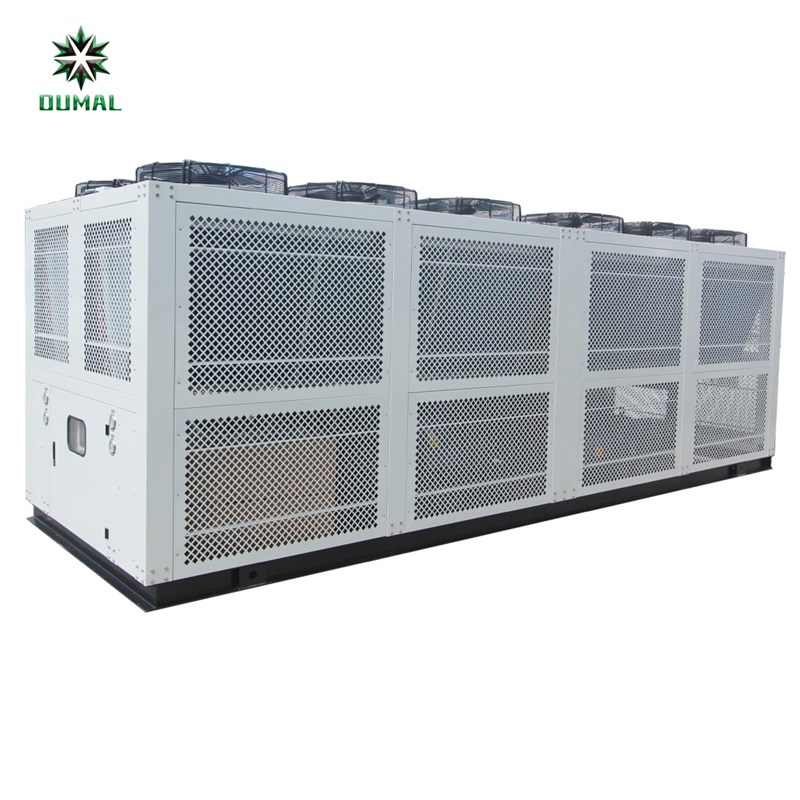
La refrigeración de procesos difiere fundamentalmente del aire acondicionado comercial estándar. Una unidad HVAC comercial enfría el aire ambiente siguiendo una curva lenta, mientras que un enfriador de proceso industrial debe absorber choques térmicos repentinos y de alta temperatura provenientes de sistemas hidráulicos, barriles de extrusión o reacciones químicas exotérmicas. Cuando los gerentes de planta seleccionan un enfriador basándose en estimaciones aproximadas en lugar de unidades térmicas británicas (BTU) o kilovatios (kW) reales, la producción sufre inmediatamente.
Considere una unidad subdimensionada. Cuando las temperaturas exteriores de verano alcanzan los 38°C (100°F), la disipación de calor del condensador cae drásticamente. Un enfriador enfriado por aire subdimensionado no puede eliminar el calor lo suficientemente rápido. La presión de descarga del refrigerante aumenta, lo que provoca un disparo de seguridad por alta presión (HP) que apaga el compresor. En una instalación de moldeo de plástico, un enfriador detenido detiene instantáneamente el agua de enfriamiento a través de las cavidades del molde, lo que hace que las piezas de plástico se peguen, se deformen y se quemen dentro del herramental.
Por otro lado, comprar una unidad sobredimensionada pensando que "más grande es más seguro" crea daños mecánicos igual de rápido. Cuando un enfriador es demasiado grande para la carga base continua, el sistema enfría el circuito de fluido en minutos y se apaga. Minutos después, el agua de proceso se calienta, obligando al compresor a reiniciarse. Este patrón de ciclos (arrancar más de cuatro a seis veces por hora) consume enormes amperajes de rotor bloqueado (LRA), desgasta los contactores y evita que el refrigerante haga circular el aceite de lubricación de regreso al sumidero del compresor. El resultado es el desgaste de los rodamientos y una falla mecánica prematura.
Una instalación de refrigeración de procesos confiable debe funcionar entre el 70% y el 85% de su capacidad nominal durante la producción normal. Este equilibrio deja margen para las temperaturas máximas de verano mientras evita el ciclo corto destructivo del compresor.
Para determinar el tonelaje exacto necesario para su maquinaria, utilice ecuaciones estándar de transferencia de calor sensible. Puede medir los parámetros directamente desde su equipo existente utilizando manómetros de presión/temperatura simples y un medidor de flujo ultrasónico.
Si mide los caudales en metros cúbicos por hora y las temperaturas en Celsius, utilice esta ecuación métrica:
Capacidad de enfriamiento Q (kW) = Caudal (m³/h) × ΔT (°C) × 1.163
(Donde ΔT = Temp. del agua de retorno del proceso - Temp. del agua de suministro enfriada; 1.163 es el factor de calor específico para el agua)
Por ejemplo, si su máquina requiere 15 m³/h de agua enfriada que entra a 12°C y regresa caliente a 18°C:
Si su planta opera con unidades imperiales estadounidenses, calcule la producción total de calor en BTU/hr:
Q (BTU/hr) = Caudal (GPM) × 500 × ΔT (°F)
(Donde 500 = 8.33 lbs/gal × 60 min/hr × 1.0 calor específico del agua; 1 TR = 12,000 BTU/hr)
Si una línea de anodizado necesita 60 GPM de agua enfriada de 65°F a 50°F (ΔT = 15°F):
Al diseñar enfriadores para la fabricación de plásticos, determinar el caudal de agua exacto a través de los canales internos de refrigeración del molde puede ser difícil. Los ingenieros calculan la generación de calor en función del rendimiento horario de la resina polimérica:
| Tipo de polímero | Temperatura media de fusión (°C) | Temperatura de expulsión de la pieza (°C) | Requisito de refrigeración (kW por 100 kg/h) |
|---|---|---|---|
| Polietileno de alta densidad (HDPE) | 210 – 260 | 40 – 60 | 17.5 – 19.0 kW |
| Polipropileno (PP) | 220 – 270 | 50 – 70 | 18.0 – 20.0 kW |
| Poliestireno (PS / ABS) | 190 – 240 | 55 – 70 | 10.5 – 12.0 kW |
| Policloruro de vinilo (PVC rígido) | 170 – 200 | 45 – 55 | 8.5 – 10.0 kW |
| Policarbonato (PC) / Nailon PA66 | 280 – 320 | 80 – 100 | 13.0 – 15.0 kW |
Nota: Recuerde siempre tener en cuenta el calor del aceite hidráulico si la máquina utiliza una unidad de sujeción hidráulica en lugar de un sistema servo totalmente eléctrico. Las unidades de potencia hidráulica suelen añadir 0.25 kW adicionales de calor por cada caballo de fuerza del motor al circuito de agua.
Una vez que calcule su requisito total de kilovatios o tonelaje, la siguiente decisión es elegir el método de rechazo de calor: enfriado por aire o enfriado por agua. Ningún sistema es universalmente superior; la elección depende de la distribución de su planta, el clima local, el costo del agua y las horas de producción diarias.
| Criterios de ingeniería | Enfriadores industriales enfriados por aire | Enfriadores industriales enfriados por agua |
|---|---|---|
| Mecanismo del condensador | Bobinas de cobre con aletas de aluminio y ventiladores de escape axiales montados en la parte superior | Condensador de carcasa y tubos conectado a una torre de refrigeración abierta externa |
| Requisito de reposición de agua | Cero (Circuito de agua cerrado herméticamente) | Se requiere reposición continua de agua para compensar la evaporación y la deriva de la torre |
| Eficiencia energética (COP) | COP de 2,8 a 3,6 (estrechamente vinculado a la temperatura de bulbo seco del aire ambiente) | COP de 4,5 a 5,8 (funciona a temperaturas de condensación más bajas mediante bulbo húmedo) |
| Huella de la planta e instalación | Unidad compacta montada sobre bastidor. Se ubica en exteriores, en azoteas o en áreas ventiladas de gran altura. | Requiere una sala de máquinas interior dedicada más una torre de enfriamiento exterior, cuenca y tubería doble. |
| Mantenimiento de rutina | Mínimo; sople periódicamente el polvo de los serpentines aletados del condensador con aire comprimido. | Mayor; requiere dosificación de productos químicos para algas/incrustaciones, cepillado regular de tubos y limpieza de la cuenca. |
| Escenario de producción de mejor ajuste | Cargas de 3 TR a 120 TR; regiones secas o heladas; instalaciones sin personal de tratamiento de agua. | Plantas de 100 TR a más de 500 TR; producción continua las 24 horas; tarifas locales de agua bajas. |
Para instalaciones por debajo de 100 toneladas donde la simplicidad es primordial, nuestros enfriadores scroll enfriados por aire ahorran un trabajo sustancial de mantenimiento y tuberías civiles iniciales. Sin embargo, para cargas de enfriamiento central que superen las 100 toneladas y operen 24/7/365, la menor temperatura de condensación de un sistema de tornillo enfriado por agua puede ahorrar decenas de miles de dólares en electricidad cada año.
Especificaciones de componentes críticos que evitan el tiempo de inactividad de la producción
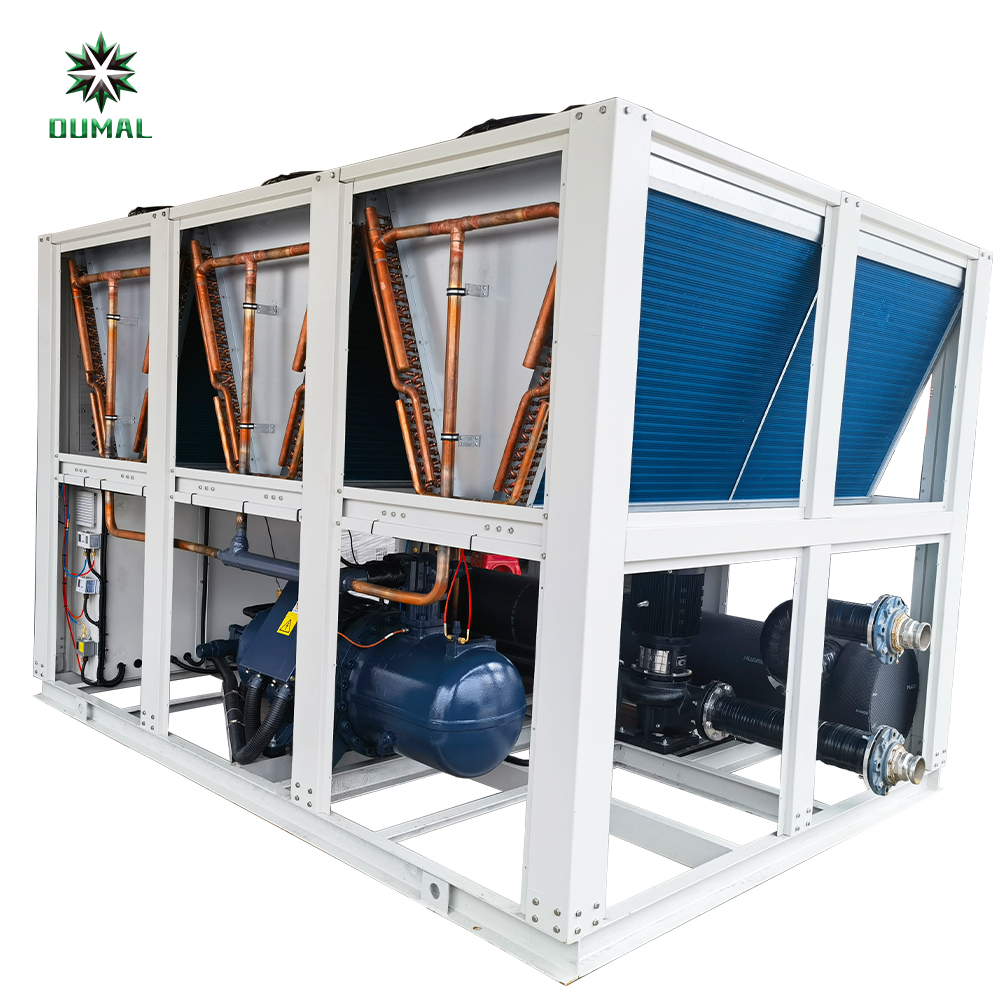
Los cálculos de dimensionamiento establecen el tonelaje necesario, pero la selección interna de los componentes determina la vida útil operativa. Los enfriadores industriales económicos escatiman en materiales, lo que genera corrosión temprana en el serpentín, medición errática del refrigerante y bloqueos frecuentes del control. Oumal construye cada paquete con componentes mecánicos de grado industrial:
El compresor impulsa todo el ciclo de refrigeración. Seleccionamos la arquitectura del compresor basándonos estrictamente en los requisitos de trabajo continuo:
A pesar de que muchos proveedores económicos instalan intercambiadores de calor de placas soldadas (BPHE) en todos los modelos, los intercambiadores de placas se ensucian y obstruyen fácilmente en entornos industriales que contienen incrustaciones de tuberías, óxido o agentes desmoldantes. Para circuitos de agua industrial sin tratar, Oumal utiliza evaporadores de casco y tubo de pared gruesa con tubos de cobre ranurados. Los cabezales de agua de los extremos son completamente desmontables, lo que permite a los mecánicos de mantenimiento cepillar mecánicamente los tubos internos durante el mantenimiento programado sin reemplazar todo el intercambiador de calor.
Las válvulas de expansión térmica mecánicas (TXV) responden lentamente a los cambios rápidos de temperatura del fluido, lo que provoca una falta temporal de suministro en el evaporador o el retorno de líquido al compresor. Oumal integra válvulas de expansión electrónica (EEV) impulsadas por motores a pasos de precisión. En combinación con los transductores de presión de Danfoss y Emerson, nuestros sistemas ajustan el flujo de refrigerante en milisegundos, manteniendo un control constante del sobrecalentamiento incluso durante variaciones severas de producción.
Cada enfriador industrial Oumal cuenta con un PLC dedicado Siemens o Schneider vinculado a una pantalla táctil industrial multilingüe. El programa de control monitorea activamente la presión de succión, la presión de descarga, la temperatura de la bobina del motor, la secuencia de fases y los caudales de fluido. Los puertos de comunicación estándar Modbus-RTU / RS485 y Profinet permiten a su equipo de ingeniería monitorear el estado del enfriador directamente desde la sala de control central o el sistema SCADA de la fábrica.
De manera crucial, nuestros paquetes incorporan tanques amortiguadores de acero inoxidable aislados de celdas cerradas de gran calibre. El tanque agrega inercia térmica a su circuito de tuberías de agua. Cuando la maquinaria de su proceso se detiene o hace una pausa para cambios de molde, el gran volumen amortiguador evita que la temperatura del agua caiga instantáneamente al punto de ajuste, eliminando los ciclos erráticos de encendido/apagado del compresor.
Así es como el dimensionamiento calculado y la selección adecuada de componentes resuelven los cuellos de botella reales de producción en las plantas de diferentes industrias:
Desafío: Un proveedor de piezas para automóviles que operaba dieciséis prensas de moldeo por inyección de 450 toneladas luchaba contra tiempos de ciclo inestables (que variaban entre 32 y 42 segundos) durante los meses de mayor calor en verano. Las temperaturas de la superficie del molde se desviaban constantemente por encima de los 24 °C debido a un circuito obsoleto de torre de enfriamiento abierta que iba directamente a los moldes, lo que provocaba marcas de rechupado en la superficie y altas tasas de desecho en los embellecedores automotrices.
Solución: El equipo de ingeniería de Oumal calculó el rendimiento total de plástico (480 kg/h de resina ABS/PC) más la disipación de la unidad de potencia hidráulica, dimensionando un sistema central de enfriador de tornillo enfriado por agua de 90 toneladas. La unidad se combinó con un tanque de reserva externo de acero inoxidable aislado de 4000 litros y bombas de distribución dobles.
Resultado: El agua de enfriamiento del molde se estabilizó en un valor constante de 10 °C ±0,5 °C durante todo el año. Los tiempos de ciclo de moldeo disminuyeron de 38 segundos a 27 segundos constantes, lo que aumentó el rendimiento general de la planta en un 28,9 % y redujo las tasas de desecho estacionales a casi cero.
Desafío: Una cervecería comercial en crecimiento requería un enfriamiento rápido del mosto de 95°C a 18°C en 45 minutos, mientras mantenía simultáneamente doce bodegas de fermentación de 60 barriles a una temperatura constante de -2°C a 4°C.
Solución: Debido a que las temperaturas del proceso descendían por debajo del punto de congelación, el agua pura no era una opción. Diseñamos un enfriador de tornillo de glicol de baja temperatura de 45 HP de doble circuito configurado para una mezcla de propilenglicol de grado alimenticio al 30%, con circuitos de refrigeración independientes dobles.
Resultado: Durante los días de mayor producción, ambos compresores de tornillo Hanbell operan en tándem para absorber la carga térmica máxima del enfriamiento del mosto caliente. Durante los días de mantenimiento constante, el PLC descarga un compresor y reduce el segundo al 50% de su capacidad, disminuyendo el consumo eléctrico mensual de la cervecería en un 34%.
Un dimensionamiento preciso del enfriador protege su producción diaria, reduce el consumo de energía de la fábrica y garantiza una alta consistencia del producto. Shenzhen Oumal Refrigeration Machinery Co., Ltd. aporta más de quince años de experiencia en ingeniería especializada, suministrando enfriadores industriales robustos montados sobre bastidor para operaciones de fabricación en 39 países. Ya sea que necesite una unidad portátil de scroll individual o una planta enfriadora central de múltiples compresores, nuestros ingenieros de aplicaciones proporcionan un modelado completo de carga térmica y esquemas de tuberías CAD adaptados directamente al diseño de su proceso.
Comuníquese hoy mismo con el equipo técnico de Oumal con sus caudales de fluido y temperaturas de operación. Proporcionaremos un cálculo completo de carga térmica y una propuesta técnica directa de fábrica para sus instalaciones.
Para convertir kilovatios (kW) de capacidad de enfriamiento térmico en toneladas de refrigeración industrial (TR), divida la cifra total de kilovatios por 3.517. Por ejemplo, un enfriador de 350 kW entrega aproximadamente 99.5 TR (350 / 3.517). Para convertir TR en unidades térmicas británicas por hora (BTU/hr), multiplique el tonelaje por 12,000.
Un tanque de agua aislado sirve como amortiguador térmico para el circuito de fluido. En entornos de fabricación donde las máquinas arrancan, se detienen o hacen pausas frecuentemente para cambios de molde, el volumen de agua dentro del tanque absorbe los choques térmicos inmediatos. Esto evita cambios rápidos en la temperatura del fluido y detiene el daño al compresor por ciclos cortos rápidos.
Los enfriadores HVAC están diseñados estrictamente para el aire acondicionado estacional de espacios en rangos estrechos de temperatura del agua (típicamente 7°C de suministro / 12°C de retorno). Los enfriadores de proceso están construidos para entornos industriales exigentes y continuos de 24/7. Manejan fuertes choques térmicos, amplias variaciones en el flujo de fluido, polvo en el aire, atmósferas corrosivas y bajas temperaturas de fluido hasta niveles bajo cero utilizando mezclas de glicol.
El agua pura no debe operarse en puntos de consigna inferiores a 5°C (41°F) porque la temperatura de la superficie interna del evaporador funciona de 3°C a 5°C más fría que el agua a granel, lo que arriesga la congelación interna de los tubos y la ruptura estructural. Para puntos de consigna desde 4°C hasta -40°C (comunes en cervecerías, reactores químicos y procesamiento de alimentos), es obligatoria una mezcla de glicol industrial inhibido para reducir el punto de congelación del fluido.
Sí. Oumal fabrica todos los paneles eléctricos para adaptarse a las redes eléctricas regionales de todo el mundo. Suministramos habitualmente enfriadores industriales cableados para 3PH-220V/230V-60Hz (Filipinas, México, América Latina), 3PH-380V/415V-50Hz (Europa, Asia, Medio Oriente, África) y 3PH-460V/480V/575V-60Hz (Estados Unidos y Canadá), completos con certificaciones eléctricas regionales.



 es
es en
en